
Home → Cardox CO2 System
Non-explosive and no vibration — and it works at full operating temperature, so your kiln never has to cool down.
Cardox India is the manufacturer and service provider of the Cardox blockage clearing system in India. A high-strength reusable steel tube is filled with liquid carbon dioxide, a chemical heater and a rupture disc. A small electrical charge converts the liquid CO2 to gas; pressure builds until the rupture disc bursts and the gas — now 600 times its original volume — discharges through a shaped nozzle to create a powerful heaving force.
The whole event takes milliseconds. A single tube can dislodge over 3 tonnes of blockage.
Pressure is regulated, not fixed. The system runs anywhere from 1,200 bar (18,000 psi) to 3,000 bar (40,000 psi) — matched to the material and to what the vessel and its refractory can take. This is what separates it from a shotgun or an air cannon: the force is chosen, aimed and repeatable.
The tube discharging inside a vessel — the whole event, slowed down.
The tube is the whole system. There is no charge, no detonator and no explosive — only liquid carbon dioxide, a chemical heater and a disc engineered to burst at a chosen pressure.

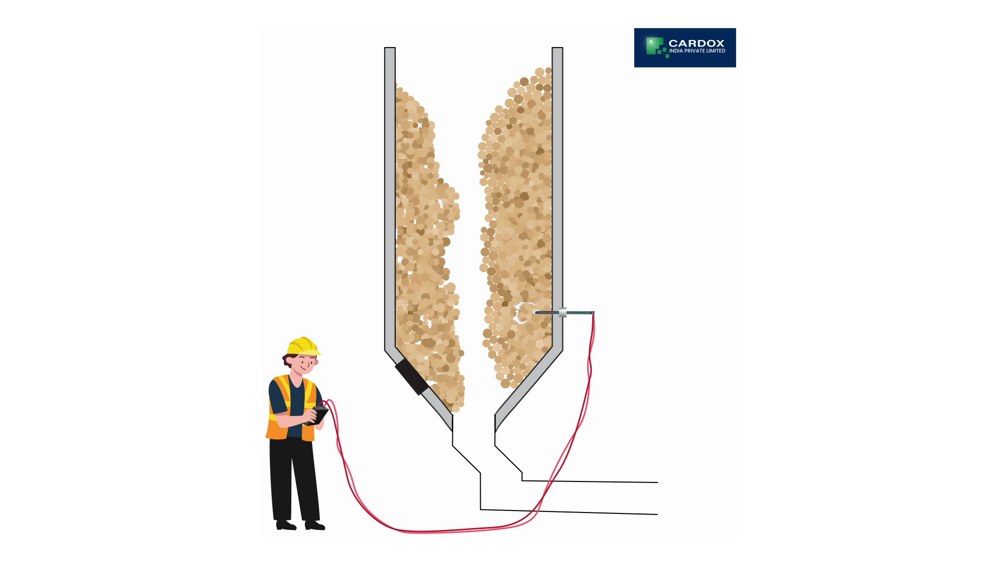
Cardox is applied either through small sockets mounted permanently onto the vessel wall, or through existing inspection hatches. Either way, nobody enters the vessel.
With sockets fitted, the sequence is simple: the sealing plug is removed, a hole is made in the product, the tube is inserted through the socket to a predetermined depth and discharge direction, and it is activated. Afterwards the tube is removed and the sealing plug replaced — the vessel returns to normal operation until the next time it is needed.
Because depth and direction are pre-set by the coupling, the discharge is aimed into the blockage and away from the vessel wall. That control is what minimises any risk to refractory.
The real advantage of permanent sockets: once a vessel is fitted, blockages can be cleared during production. No outage to schedule, no cooling period, no lost campaign days.


Not every vessel can take a welded fitting, and not every plant can raise a hot-works permit at short notice. There are three ways to get a tube into a vessel:
| Socket type | When it is used |
|---|---|
| Welded socket | The standard permanent fitting. Welded through the vessel wall at the point where build-up forms, then capped with a sealing plug between uses. |
| Flanged socket | Bolts onto an existing flange — a level probe boss, a temperature port, an inspection branch. No welding, so no hot-works permit, and it can be fitted while the plant is running. |
| Portable straight socket | Carried to the vessel and used through an existing opening, then taken away again. Nothing is left on the wall at all. |
Angled sockets are used where the build-up is not directly opposite the wall — they let the discharge reach up into a cone or along a ledge that a straight fitting could not.
A detail that matters on coal and pet coke. When a socket is welded to a bunker wall, the weld runs only around the outer edge of the socket. Heat is never applied through to the material inside. It is a small thing that decides whether an HSE department signs the work off.
Build-up is not one substance. Ash from a waste-to-energy boiler can be soft in one hopper and set like rock in the next. Nothing about the discharge is left at a default — three things are chosen before a tube goes anywhere near your vessel.
Five types — B20, B37, F57, F57-L and C74 — carrying 0.29 kg to 1.25 kg of liquid CO2. Silo and kiln work normally takes the C74 or B37; F57 and F57-L are the rock and tunnelling tubes; B20 handles secondary breaking and thin-section concrete.
Disc thickness sets the pressure at which the tube lets go, anywhere from 1,200 to 3,000 bar. This is the dial: soft material is never hit with the force reserved for a set mass.
A multi-holed head spreads the discharge; a straight-shot head concentrates it one way. Extension pipes fix how deep the tube sits, so the gas goes into the blockage rather than against your wall.
Where it does not work, and we will say so. The discharge breaks material and lifts slabs, but the force does not carry across a construction joint. On a jointed concrete structure each bay has to be treated as its own piece of work. A contractor who tells you otherwise has not done it.
Every kiln operator asks the same question: does this damage the lining? It is the right question, and the answer is in how the tube is set, not in any claim about the gas.
Minimum clearance held between the brickwork and the discharge nozzle before a tube is activated.
Sockets set as six nozzles diametrically opposed, twelve in total, with a further row nearer the burning zone if the ring tends to move.
Weakening found when kilns cleared this way were later examined by independent kiln specialists.
Extension pipes hold the tube steady and protect the lining, so the discharge cannot be delivered against the brick. Where those inspections found wear, it came from the ring forming and breaking away — not from clearing it.
The same tube does two quite different jobs. Inside a vessel it breaks material that has set; in the ground, it breaks the ground itself.
Set masses, plugged cones, blocked extraction points and gates.
Ring build-up, cyclone jams, riser ducts, kiln inlet and coolers.
Blast furnace applications, uptake pipes, slag pot deskulling and furnace build-up.
Dimensional stone, general quarrying, coal and ore winning, boulder breaking, gaseous mines.
Rock excavation beside live roads and structures, tunnelling, trenching, shaft sinking, foundations.
Mass, lightly and heavily reinforced concrete, and underwater work where divers stay in the water.
The rock, quarrying, civils and concrete side is set out in full — yields per tube by strata, and how it compares with hydraulic splitters, expansive agents and breakers — on the CO2 rock breaking page.
| Method | What it actually costs you |
|---|---|
| Sending workers inside | Up to 8 days and as many as 30 workers, plus shutting the kiln down and waiting for it to cool. And it is the most dangerous job in the plant. |
| Air blasters | Plants report efficiency losses of up to 75%, on top of high installation, equipment and maintenance costs, and continuous running costs. |
| Water injection / shotgun | Operators exposed to flying debris, or forced dangerously close to the blast area. |
| Cardox System | Hours, not days. One or two workers. No efficiency loss — every tube delivers full pressure. Typically pays for itself in a single application. |
Working life of a tube. Everything except the disc and the CO2 is reused.
Typically enough to restore full capacity, with little or no downtime.
To recharge a tube with liquid CO2 and put it back to work.
Continuous running cost. It is used when build-up accumulates, and virtually no maintenance in between.
Cardox India is the manufacturer and service provider for the Cardox System in India. However you want to work, the equipment comes from us directly.
Tubes, sockets, plugs, firing equipment and the training to run it — installed on your vessels.
We fit permanent sockets to your vessel walls so future blockages clear during production.
For a campaign or a shutdown, at reasonable rates and with no capital outlay.
We bring the crew, the equipment and the experience.
Reusable tubes with a 15+ year working life, recharged in under a minute, supplied direct.
We ship internationally with commissioning, operator training and spares.
Tell us the vessel, the material and whether the plant is running. We will tell you whether Cardox clears it, how long it takes and what it costs.
Plant already down? Mark your message EMERGENCY — we mobilise.