
Cement silo cleaning is the single job we are called for most, and it is the one with the least forgiving material. Cement is hydraulic — it does not merely cake when it meets moisture, it reacts and hardens. Once that has happened against a silo wall, no amount of aeration or vibration is getting it back.
| Symptom | What is happening inside |
|---|---|
| Silo fills sooner than it should | Wall coating has reduced the effective diameter. You are filling a smaller vessel than the nameplate says. |
| Erratic discharge, then nothing | Ratholing. Cement runs down a narrow channel while the bulk sits set against the wall. |
| Aeration no longer helps | Coating has buried the fluidising pads. Air is going into the wall, not the product. |
| Lumps reaching dispatch | Set material breaking away in pieces — a product quality problem, not just a flow one. |
| Truck and bulker loading slows | Restricted extraction. Every dispatch takes longer, and the queue builds through the day. |
| One cell of a multi-cell silo unusable | Written off as "the bad cell" — and quietly left that way for years. |
The number nobody calculates. Capacity falls with the square of the radius. A 12 m diameter cement silo carrying 250 mm of coating has lost roughly 8% of its volume — and a silo running with a rathole through set material can be holding less than half its rating while the level indicator still reads full.
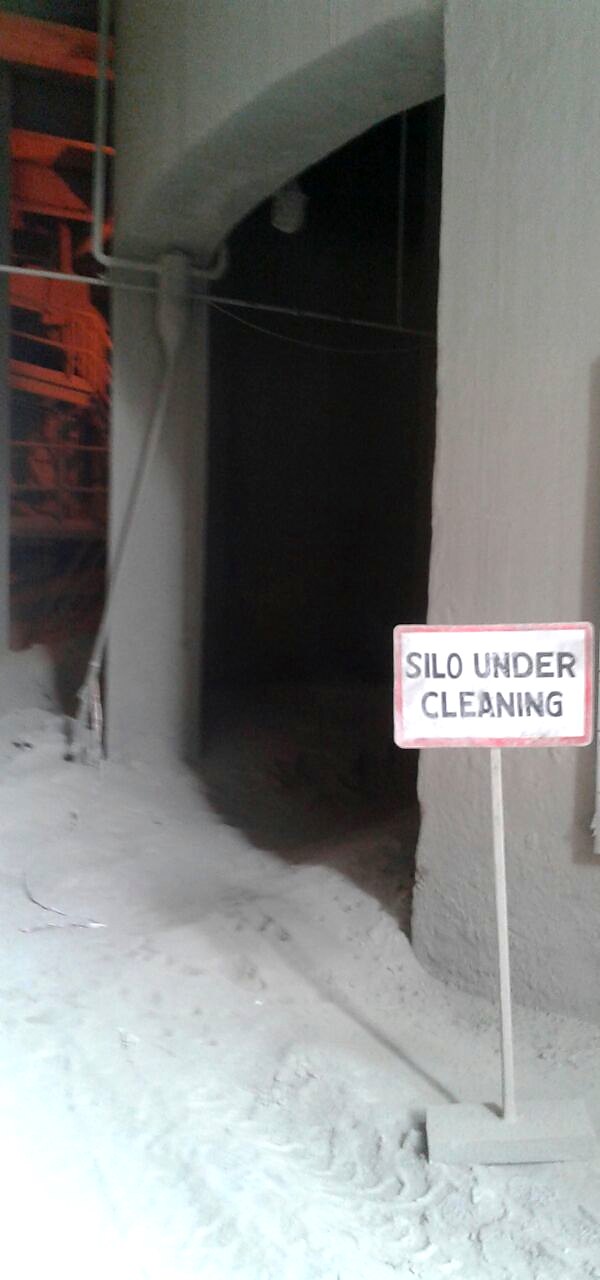
Survey first. We inspect through the top hatch and establish how far the coating extends and how hard it has set. That decides the whipset and the approach, and it is why we do not quote blind.
Whipping recovers the wall and the aeration. The boom enters through the existing top hatch and the whipsets clean coating off the wall — and off the fluidising pads themselves, so the silo can aerate properly again rather than being nursed. Non-destructive: no gouging of concrete, liners or welds.
Cardox CO2 for the cone, gates and extraction points. This is where cement sets beyond anything mechanical will move, and where manual clearing is most dangerous. A tube fired through a wall socket delivers a controlled heave — regulated between 1,200 and 3,000 bar to suit the vessel — and breaks the mass in milliseconds.
Recovered, not wasted. Dislodged cement discharges through your normal outlet and conveying system. It is saleable product, not a disposal cost.
Nothing wet. Water is what set it. Nothing we use introduces moisture.
From small day bins of 100–200 MT up to 25,000 MT storage silos, at heights of up to 60 metres.
We do this for the largest cement producers in India — UltraTech, ACC, Ambuja, Dalmia, Shree, Ramco, JK, India Cements, Heidelberg and Chettinad — across more than 55 plants and 500+ vessels in over 30 years. See the whole cement plant, or clinker, raw meal and blending and gypsum silos.
Or read the 59 most common questions →
Send the vessel, the material and how long it has been a problem. We come back with an approach, a duration and a price.